 |
||||||||||||
| 10 Reasons Big Question Rider Profiles Owner's Manual HOME |
Why the DC Model? DC Model Videos |
Images Video Events |
Links Velo News The Other Brands Mike's Rants |
|||||||||
10 Reasons
Why the One-Off Handcycle is the Best
 #1: Maneuverability:
Our turning radius is 9 feet. If you can't get out of the cycle to pick
it up in order to turn around in a small space (none of the athletes
I'm working with can do this), then a 30 foot turning radius completely
flavors your ride. Maneuverability is fun. If you can't even turn as
sharp as a car, then it is hard to feel comfortable in traffic. The
ONE-OFF handcycle is completely in a class by itself when it comes to
maneuverability. Ask me about the 32 foot center figure eight race. We
are also happy to race any other handcycle in backing up or doing 3
point turns.
#1: Maneuverability:
Our turning radius is 9 feet. If you can't get out of the cycle to pick
it up in order to turn around in a small space (none of the athletes
I'm working with can do this), then a 30 foot turning radius completely
flavors your ride. Maneuverability is fun. If you can't even turn as
sharp as a car, then it is hard to feel comfortable in traffic. The
ONE-OFF handcycle is completely in a class by itself when it comes to
maneuverability. Ask me about the 32 foot center figure eight race. We
are also happy to race any other handcycle in backing up or doing 3
point turns.
#2: Crank orientation: The ONE-OFF handcycle is designed from the ground up to use the opposed crank position. Over rough terrain, this allows the rider to hold their weight up off the steering wheel with the two crank handles in the horizontal position It allows the arm muscles to work in opposition for the maximum possible 360 degree power delivery, minimizing dead spots. On smooth level pavement, the road racers seem to be slightly faster, but as soon as the road starts uphill, our opposed orientation begins to take over. The steeper the hill, the more important it is to have the continuous power that our bike delivers.
#3: Rider positioning/power delivery: The prone rider position of the ONE-OFF handcycle allows the weight of the rider's upper body to be put to use in adding power to the cranks. Why is it that recumbent bicycles are known for their poor climbing performance? Because they have to rely exclusively on their leg muscles for power. The rider's weight, cannot be utilized. The ONE-OFF handcycle allows the rider to lean forward onto the cranks, straighten an elbow, and lean onto the cranks just like an able bodied cyclist getting out of the saddle.
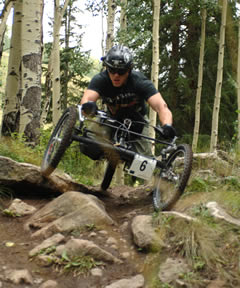
#4: Rider Positioning/Unweighting: This is the key to our success at downhill racing. The prone riding position of the ONE-OFF handcycle places the rider's weight nearly straight above the cranks and handlebars. This allows the rider to lift their upper body up off of the sternum support and and take their weight onto their arms. This is again analogous to the able bodied cyclist getting out of the saddle. It does a lot more than just provide more power. It allows the rider to rise up to absorb bumps and rough terrain through the elbows instead of having to just sit and take it through the seat. The ONE-OFF handcycle, with a little practice, can be backed up and hopped in all sorts of ways. We go up bigger and bigger curbs every day. Who knows how good we will get at this. With the recumbent position, these skills are simply not available. The difference between sitting with all your weight on the seat, and being able to lift our weight up onto your arms is absolutely profound.
#5: Climbing traction: Weight transfer is everything here. Everybody else is front wheel drive. The super low gearing of the ONE-OFF handcycle wouldn't work without the traction that comes from placing the rider's weight onto the drive wheel. This is one of our favorite demonstrations. There is no way you can pedal up the super steep grassy slope at our local state park without cracking a smile.
#6: High speed cornering: You show me someone who says, My handcycle doesn't tend to tip over and I'll show you someone who either isn't going fast or isn't turning. Any vehicle light enough to be human powered, that has more than 2 wheels, wants to tip over during hard cornering. The key to overcoming this is to get the rider's weight as low as possible and/or as far to the inside of the turn as possible. High performance leg powered recumbent tricycles (Greenspeed, Wind Cheetah) do the best they can by placing the rider's center of gravity very low. But since they are recumbents, the rider is basically stuck in the seat and can't lean to the inside of the turn to corner harder. The best example I know of to describe how the ONE-OFF handcycle corners comes from racing motorcycle side cars. (see links) The way these people lean clear off the inside, with their shoulder practically touching the pavement, is very useful to see when learning to ride our bike. ONE-OFF handcycle allows extreme side to side upper body movement. This is equally true for side hills.
#7: High speed stability: Just like with high speed cornering, any vehicle light enough to be human powered has to really pay attention to this. There is nothing more demoralizing than cranking your brains off up a long climb only to have to brake on the downhill. Through extensive testing of adjustable prototypes, we have arrived at a basic understanding of 3 wheeled human powered vehicle performance at 40 mph and above. Go-karts with this same direct and quick steering are safe at 160 mph. The ONE-OFF handcycle gains stability as it gains speed. It takes a deliberate and strong turn at the handlebars to make a lane change at 40 mph. Some vehicles are inherently self stabilizing and some aren't. Ask any fork lift driver about going fast with a rear steering vehicle.
#8: Braking: Everyone knows about weight transfer to the front during hard braking. Racing motorcycles have two 12 inch diameter discs in front and practically nothing in back. A handcycle with one wheel in front and two in back obviously has one less wheel to brake with, but the comparison is more dramatic than that. With all the weight of the rider and vehicle transferring onto the one front wheel, the vehicle effectively becomes only one tire wide. Add in a downhill turn and the comparison of braking ability becomes all too obvious. Braking is like the previous two categories (cornering and high speed stability): Where the ONE-OFF handcycle is exploring the limits of tire adhesion and weight transfer, the other handcycles really aren't even safe to experiment with.
#9 Transmission: Being experts at bicycle components, we can offer any conceivable gear ratios. We have gone as low as 3/4 gear inches (this is really only useful for climbing up the side of a building with one hand). This super low gearing would be completely lost in wheel spin on a front wheel drive machine. Have you ever been riding a handcycle up hill and gotten stuck in a gear that is too high? I thought so. The lower speeds and recumbent riding position of most handcycles makes shifting on a steep hill much harder than a regular bicycle. With our transmission, if you don't like the gear your in, just stop and shift. You don't have to stop to shift, but it sure is nice to know you can. This is made possible by the two Schlumpf Mountain Drives. The Mountain Drive web site has a very good explanation of gear inches and how to calculate gear ratios. Also, please note the inevitable price increase in any of our competitors who copy our transmission.
#10 Safety/Moose Test: Last but not least, is safety. How can we encourage high speed descending and use of the chair lift and still claim to be safer?. It's true that we are giving you the low gearing and the huge rear tire to climb into some very nasty places if you choose. So in one sense, we aren't the mild mannered, bike path kind of "safe" handcycle. But when you first feel our three wheeled braking (It has been compared to a snarling German Shepherd coming to the end of its chain) you will feel safe. Likewise when you feel our "on center" handlebars, (and the way you can hit an unexpected patch of stutter bumps in a turn at 40mph) you will feel safe.
I like to refer to the Scandinavian car safety standard called the moose test. I guess significant numbers of cars roll over and crash off the road in Scandinavia from avoiding moose. It happens all the time, it's a basic element of wheeled vehicle safety: swerve and brake at the same time and then swerve back to avoid going off the road. No one would disagree, among handcycles, we are in a category by ourselves on the moose test.